
AiAD, the method
A defensive publication. How a piece of bolted sheet metal goes from a sentence to parts a laser cuts and a brake folds, as it runs today in a working studio.
Published 6 October 2026 by KENAN GROUP LTD, Gilad Kenan, with the studio's agents CREATOR001, FAB001 and BB001. Everything on this page exists and runs as written on this date.
1 · Why this page
This page places the AiAD method in the public record on its date. It describes what the method is and how it works, in enough detail that the same work cannot later be claimed as new by someone else. The method was built inside the studio of Gilad Kenan, on real commissions, between 2025 and 2026. The work and the method are his and KENAN GROUP LTD's; the studio documents each step as it is made, with its date, in a register of rulings and in the software's own history.
Not on this page, by the studio's rule: the names of the workshops that cut and fold, the names of clients, and any price or rate. The works named are the artist's own, shown publicly before this date.
2 · What AiAD is
AiAD is a design engine that thinks in folded metal. It carries a piece from an idea to parts a laser can cut and a press brake can fold, bolted and never welded, and it proves every part as geometry before anything is cut. It has two faces: AiAD Studio, the software with its room, which also runs in a browser, and AiAD for Inventor, a tab inside Autodesk Inventor that prepares, checks and exports sheet-metal work the way a workshop needs it. Underneath both is one method: the artist's moves written as code, his judgment written as rules, and proof by measurement.
3 · The method, step by step
3.1 Say
A piece begins as a sentence or a picture. A language model turns the sentence into numbers inside limits the artist sets, never into geometry; a picture becomes an image of the piece. The limits are the artist's, kept as a spec with every number's unit, minimum and maximum, and a spec outside them is refused, never quietly moved.
3.2 Sculpt and facet
The picture becomes a sculpt, a mesh. The sculpt is then read for the flat panels it is really made of: planes are fitted to it, each panel becomes a facet, and where facets meet the method finds the seam. The decisive move is the weld: one corner per meeting of facets, and the stand-off between the outer skins and the inner frame read from the skins alone, so that a sculpt of any free form becomes a frame of flat plates with flat skins over it. Only the triangles that earn their place are kept.
3.3 The artist's moves as code
Every design move the artist taught was recorded on his own files, written as a verb, and proven to rebuild his file to the millimetre before it entered the method. The verbs: a sketch on a facet with projected geometry, offset, fillet, a face with the regions he clicks, bend, flange centred or from-to, corner round, a hole at a round's centre, split, derive, make components. The rule for every verb: build, measure, say, and delete what did not land.
- The foot. On each facet one sketch: offsets of 45 out, 27 out and 9 in, circles of 3.33, fillets R18 and R2.7; the frame face 3 mm into the console; the skin face 0.8 mm outward as a new body with the hole disks left out. The twin facet is built again from scratch, never mirrored as a solid.
- The seam. Where two plates meet at a dihedral angle: a flange 45 x 135 centred at 90 degrees on one plate, a flange 45 from-to on the other at the angle that closes it, face to face; the seam law is angle A plus angle B equals 360 minus the dihedral. The flange maker's rule for two flanges parallel, face to face: each at 180 minus half the dihedral. Corner rounds R21.7; the bolt holes at the rounds' centres, through both plates.
- The library lego. A wall becomes shelves and uprights: every shelf a 5 mm plate, every upright a 5 mm L open to the room. A shelf runs from its free end into the far upright and ends inside the upright's wall, one cut per upright face where a shelf ends; faces are not parts. At every shelf end on a web a flange 135 x 36 at 90 with corner rounds R13.5 and two holes through flange and web; the plate's corners beside it R5; two tabs 9 x 5 out of the back edge into the first upright's back leg, with slots at 0.18 clearance. The floor shelf's flanges bend up, the upper shelves' down.
- The sheet-metal box and the LED module: the same way, a lesson, a verb, a proof.
3.4 The law of the export
A work leaves the studio only by the law: one export per work with its cut files, its bending drawings, its bill and its manifests; the bill is load-bearing, the sites take mass and blanks from it. Every number is measured on the metal and never trusted from a parameter: the thickness, the folds, the skin gauge. The blank must hold the part. Every part is set to millimetres and proven. The A side is marked. The bolt's head sits on the skin and the nut inside; one bolt goes through the whole stack; a slot's round end is a wire pass, not a hole. Cladding is 0.8 mm while the model may draw it at 1.5. A part must fit one of three sheets, 2000 x 1000, 2500 x 1250 or 3000 x 1500, which is a limit a part must meet and never a nest. What the shop is not to make stays off the bill.
3.5 The learner: a recording becomes a recipe
The artist's lessons are recorded inside Inventor by the studio's own recorder, which writes each move with the geometry it stood on: a hole stands on a point from a sketch with projected geometry, never on a free click. The recording becomes a move list, the move list a recipe with its measured expectations, and a player rebuilds the lesson identically on the same file and refuses to run outside the range the lesson was taught on. The first recipes: the foot, with its four lessons, and the seam, with three cases. The method grows by lessons, not by code written from imagination.
3.6 The room, and the room's own unfold
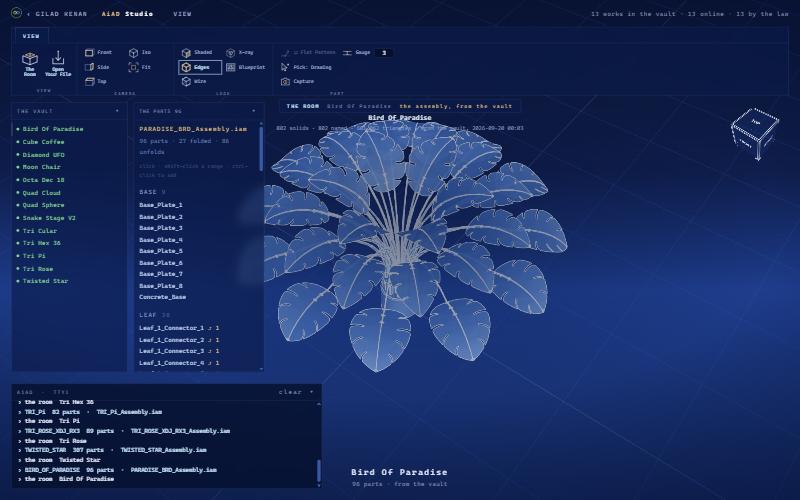
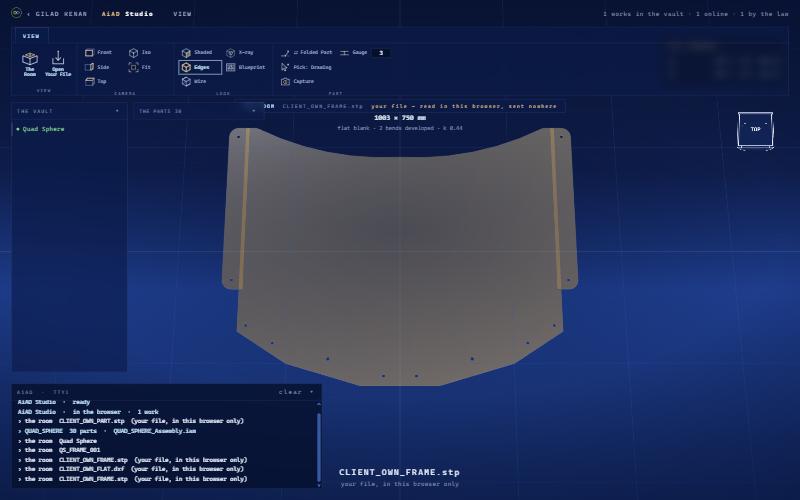
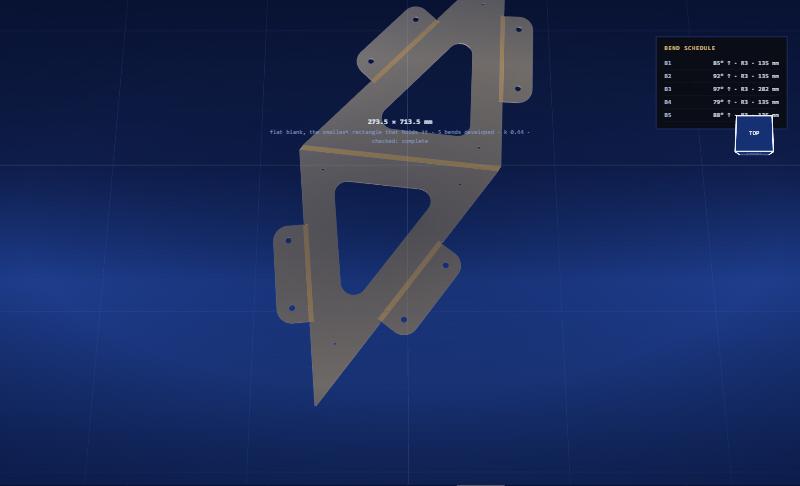
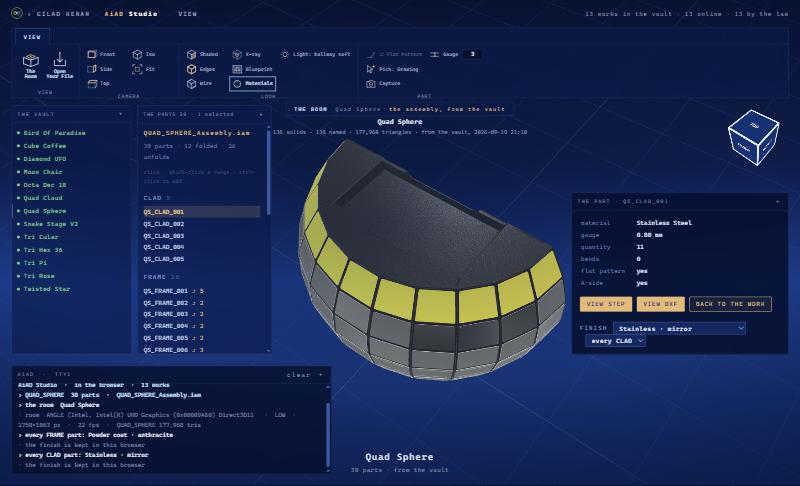
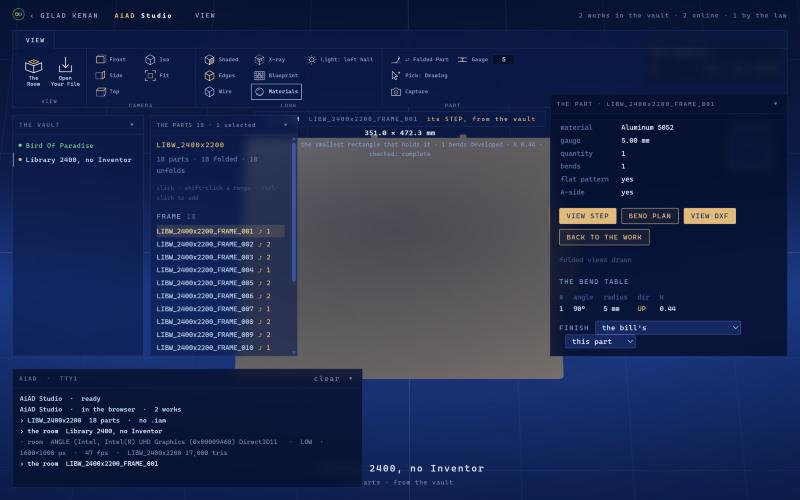
Every work stands in a room: in real materials, lit, every part named, with its parts list and each part's card. The room runs on the studio's seat and in a browser. The room unfolds a part by itself, from the solid: the faces of the part are paired across each bend's cylinders, one bend may run through several faces as one round, the bend zone lies between its own two tangent lines, and the developed length follows the K factor of the part's sheet-metal style. The unfold says of itself whether it is complete: every round in the part developed and no material left beyond a round; where it cannot, it names its refusal rather than drawing a flat that is not the part's. A judge holds the room's own unfold to the flat pattern the CAD system exported, part by part: on 6 October 2026, of 287 bent parts in 13 works, 284 unfold as the CAD system does. A client's link shows a part's flat pattern and bend plan only on parts checked right.
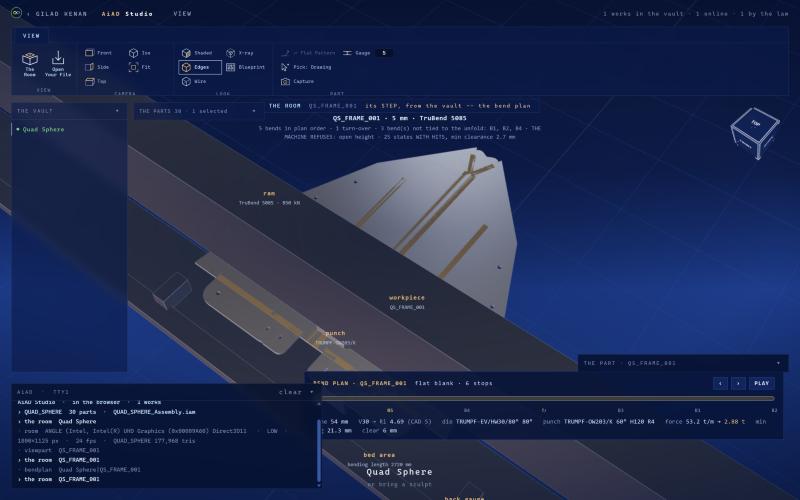
The bend plan plays on the brake: a stop for every bend and every turn-over, the part folding in plan order as it moves. The finishes are picked per part or per family, and the textures of brushed, mill, galvanized, powder-coated, anodized, wood and concrete surfaces are made in code in the browser, so nothing of a stock source is carried.
3.7 The library with no Inventor
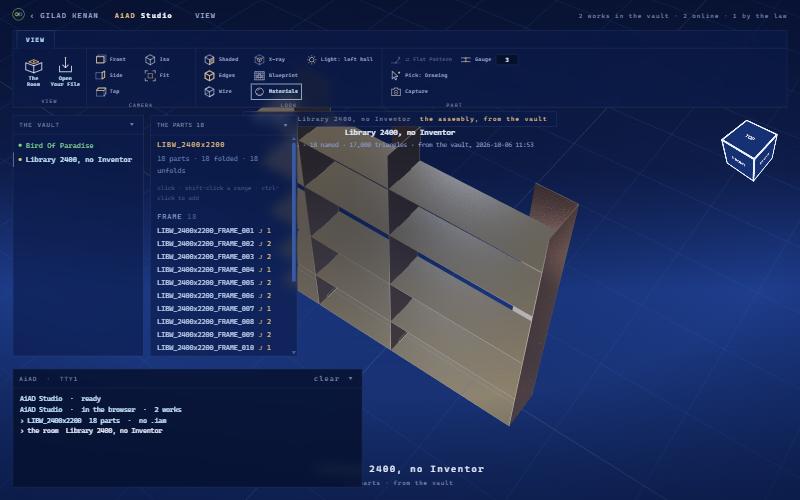
The method's first generator makes a library wall from a spec with no CAD system on any seat: the artist's rules written as geometry. On 6 October 2026, from the spec of a 2400 x 2200 x 351 wall with five shelves and three uprights, the generator made all 18 parts as solids, with their flanges, bends, holes, tabs and reliefs, each part's flat pattern by the method's own unfold, and the drawing of each flat in the CAD system's own layers. Each of the 18 was held to the file the CAD system had made of the same part from the same rules, number by number: the flat's size and area, each bend's angle, direction, inner radius, K factor and centreline, the holes, every line and arc of the flat drawing within 0.01 mm, the folded box and the mass. Eighteen of eighteen held. The wall then stood in the room in real materials, and the room's own unfold of each part said complete.
3.8 The price before the cut
Every bill is priced from a workshop's calibrated rates, so the studio knows what a piece will cost before anyone cuts anything, and a work can be exported onto one supplier's catalogue of stock. The workshops are not named here.
4 · What is measured, as of this date
| what | number | how it is known |
|---|---|---|
| works exported through the engine by the law | 13 | the Vault, one export per work |
| lines on their bills | 1,155 | counted on the thirteen bills, 6 Oct 2026 |
| bent parts whose own unfold is the CAD system's flat pattern | 284 of 287 | the judge, chain 20f505e4e89c, 6 Oct 2026 |
| parts of the 2400 wall made with no CAD system and equal to its files | 18 of 18 | the proof tables, 6 Oct 2026 |
| LED diffusers drawn, placed and proven on the works' solids | 424 | seven works, measured 16 Sep 2026 |
| the artist's lessons recorded and rebuilt identically | the foot, four lessons; the seam, three cases | the recipes and their players, Sep 2026 |
5 · The pictures
6 · The record
This page is dated 6 October 2026 and is kept, with its pictures, in the studio's own history under that date. The studio keeps a register in which every ruling of the artist is written in his words with its date, and the software's history carries every step of the method with its commit. Counsel advised the studio on this date that the method is not patentable and recommended its defensive publication; this page is that publication. The work is owned by KENAN GROUP LTD and documented as Gilad Kenan's.